


The 48-Team Era: How the Expanded Format Changes the WorldCup Dynamics
Co-hosted by the United States, Canada, and Mexico, this expanded edition promises to be the largest and most inclusive World Cup ever, bringing with it a wave of changes that will redefine the competition's dynamics, from qualification pathways to the very structure of the knockout rounds

The FIFA World Cup, football's most prestigious tournament, is set for a monumental transformation in 2026. For the first time in its history, the tournament will feature 48 teams, a significant leap from the 32-team format that has been in place since 1998.
The Road to 48 Teams: A Vision for Global Inclusion
The decision to expand the World Cup was ratified by the FIFA Council in January 2017, driven by a vision to make the tournament more globally representative and provide more opportunities for nations to participate on the grandest stage [2]. This move reflects FIFA's ongoing commitment to developing football worldwide, allowing more countries to experience the economic, social, and sporting benefits of World Cup participation. The expansion is not merely about increasing numbers; it's about fostering growth, inspiring new generations of players, and broadening the tournament's appeal to an even wider global audience.
A New Tournament Structure: 104 Matches of Pure Football
The most immediate and impactful change for the 2026 World Cup is its revised structure. The tournament will now feature 104 matches, a substantial increase from the 64 games played in the 32-team format [3]. This expansion necessitates a complete overhaul of both the group stage and the knockout rounds.
Group Stage: 12 Groups of Four
Instead of eight groups of four, the 2026 World Cup will comprise 12 groups, each with four teams [4]. This format ensures that every team plays a minimum of three group matches, maintaining competitive integrity and providing ample opportunity for teams to make their mark. The top two teams from each of these 12 groups will automatically advance to the knockout stage. Additionally, the eight best third-placed teams across all groups will also qualify, adding an extra layer of drama and strategic complexity to the group stage [4].
Knockout Stage: The Introduction of the Round of 32
With 32 teams progressing from the group stage, a new knockout round, the Round of 32, will be introduced. This means that teams will need to navigate an additional knockout match to reach the quarter-finals, intensifying the competition and demanding even greater endurance and tactical prowess. The tournament will then proceed with the traditional Round of 16, Quarter-finals, Semi-finals, and the Final, along with a third-place play-off [4].
graph TD
A[48 Teams] --> B[12 Groups of 4]
B --> C[Group Stage: 72 Matches]
C --> D[Top 2 from each group: 24 Teams]
C --> E[8 Best 3rd-placed teams]
D --> F[Round of 32: 16 Matches]
E --> F
F --> G[Round of 16: 8 Matches]
G --> H[Quarter-finals: 4 Matches]
H --> I[Semi-finals: 2 Matches]
I --> J[3rd Place Play-off]
I --> K[Final]
J --> L[Total: 104 Matches]
K --> L
Figure 1: FIFA World Cup 2026 Tournament Structure [4]
Impact on Qualification: More Slots, More Dreams
The expansion to 48 teams has led to a significant increase in the number of qualification slots allocated to each confederation. This change is particularly impactful for regions that previously had limited representation, opening doors for more nations to compete at the highest level [5].
Slot Allocation Comparison (2022 vs. 2026)
|
Confederation |
2022 Slots (32 Teams) |
2026 Slots (48 Teams) |
Increase |
|---|---|---|---|
|
AFC (Asia) |
4.5 |
8 |
+3.5 |
|
CAF (Africa) |
5 |
9 |
+4 |
|
CONCACAF (N. America) |
3.5 |
6 |
+2.5 |
|
CONMEBOL (S. America) |
4.5 |
6 |
+1.5 |
|
OFC (Oceania) |
0.5 |
1 |
+0.5 |
|
UEFA (Europe) |
13 |
16 |
+3 |
|
Inter-confederation Play-off |
2 |
2 |
0 |
|
Hosts |
1 |
3 |
+2 |
|
Total |
32 |
48 |
+16 |
Table 1: FIFA World Cup Slot Allocation Comparison [5]

Figure 2: Visual representation of FIFA World Cup Slot Allocation Comparison (2022 vs 2026)
As seen in Table 1 and Figure 2, every confederation receives a boost in guaranteed spots, with Africa and Asia seeing the most significant increases. This rebalancing aims to create a more equitable global representation, ensuring that the World Cup truly lives up to its name.
Pros of Expansion: A Broader Horizon for Football
Increased Global Participation
The primary benefit of the 48-team format is the opportunity for more nations to participate. This not only allows more players to fulfill their dreams of playing in a World Cup but also ignites national pride and interest in football in countries where it might not be the dominant sport. The expanded field means more diverse playing styles, cultures, and narratives will be showcased, enriching the tournament experience for everyone.
More Diverse Competition and
New Rivalries
With more teams, there is a greater chance for unexpected upsets and the emergence of new footballing rivalries. The expanded format could lead to more competitive matches in the group stage, as third-placed teams will also be fighting for qualification, rather than just the top two.
Economic Benefits
An expanded tournament means more matches, more host cities, and a longer duration, all of which translate to increased revenue opportunities for FIFA and the host nations. This includes higher broadcasting rights, increased sponsorship deals, and a significant boost to tourism and local economies in the 16 host cities across North America [6].
Cons and Challenges of Expansion: Navigating the New Landscape
Player Welfare and Fatigue
One of the most significant concerns is the increased burden on players. With more matches and potentially longer tournament durations, player fatigue and the risk of injury could rise. This will necessitate careful squad management and rotation by national team coaches [7].
Quality Control and Dilution of Competition
Critics argue that expanding the tournament could dilute the overall quality of play, as more teams of potentially lower caliber qualify. While the aim is inclusion, there is a fear that some group stage matches might lack the intensity and competitive edge traditionally associated with the World Cup.
Logistical Complexities
Hosting a 48-team tournament across three vast countries presents unprecedented logistical challenges. Travel distances between host cities can be considerable, impacting team recovery and fan experience. Coordinating security, transportation, and accommodation for an even larger influx of teams, officials, and supporters will be a monumental task [8].

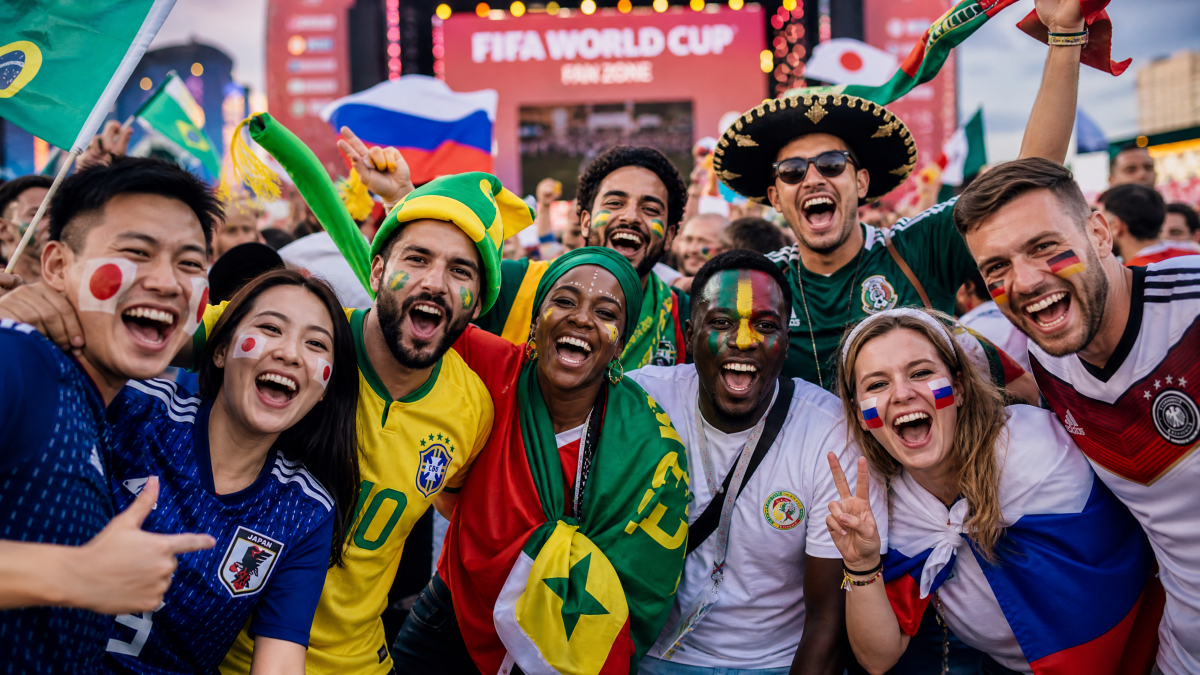
Figure 3: Global fans celebrating the spirit of the World Cup [9]
The Verdict: A New Era for the Beautiful Game
The 48-team FIFA World Cup 2026 marks a bold new chapter for international football. While it presents its share of challenges, particularly concerning player welfare and logistical complexities, the potential benefits of increased global participation, diverse competition, and economic growth are substantial. The tournament promises to be a vibrant celebration of football, bringing together more nations and cultures than ever before, and offering a fresh dynamic to the world's most beloved sporting event.
As the countdown to June 11, 2026, begins, the football world watches with anticipation to see how this expanded format will unfold and what new legends will be forged in the crucible of the biggest World Cup in history [10].
References
[1] FIFA. "FIFA World Cup 2026™." FIFA.com, https://www.fifa.com/en/tournaments/mens/worldcup/canadamexicousa2026[2] BBC Sport. "World Cup 2026: Fifa reveals allocation for 48-team tournament." BBC.com, 30 March 2017, https://www.bbc.com/sport/football/39448474[3] FIFA. "FIFA World Cup 2026™ | Fixtures, groups, teams & more." FIFA.com, 30 March 2026, https://www.fifa.com/en/tournaments/mens/worldcup/canadamexicousa2026/articles/fifa-world-cup-2026-hosts-cities-dates-usa-mexico-canada[4] FIFA. "World Cup 2026 groups: How teams qualify and tie-breakers." FIFA.com, 19 April 2026, https://www.fifa.com/en/tournaments/mens/worldcup/canadamexicousa2026/articles/groups-how-teams-qualify-tie-breakers[5] Wikipedia. "2026 FIFA World Cup qualification." Wikipedia.org, https://en.wikipedia.org/wiki/2026_FIFA_World_Cup_qualification[6] Roadtrips. "2026 World Cup Cities Map and Venues." Roadtrips.com, https://www.roadtrips.com/world-cup/2026-world-cup-packages/venues/[7] Al Jazeera. "FIFA World Cup 2026 talking points: NFL-style half-time show, kits ..." Aljazeera.com, 5 June 2026, https://www.aljazeera.com/news/2026/6/5/fifa-world-cup-2026-super-bowl-half-time-show-kits-football-talking-points[8] Britannica. "2026 FIFA World Cup: Complete Guide to the Tournament." Britannica.com, https://www.britannica.com/event/2026-FIFA-World-Cup[9] Image generated by Manus AI.
[10] ESPN. "2026 FIFA World Cup: Format, groups, full match schedule, more."ESPN.com, 1 April 2026, https://www.espn.com/soccer/story/_/id/47108758/2026-fifa-world-cup-format-tiebreakers-fixtures-schedule





Comments (0)